The Grand Axis of Paris began in the Tuileries
Gardens in the seventeenth century and was projected beyond
the River Seine in the twentieth century, becomig the pedestrian
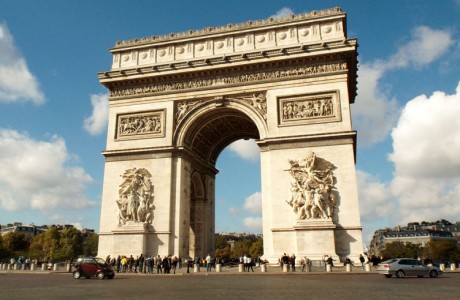
core of a major business district. It runs through the Arc
de Triomphe and culminates in the Grand Arche, a hollow
office building topped with an art gallery and viewing platform.
Dan Kiley, the American landscape architect and garden designer,
was responsible for a 0.5 mile stretch, the Dalle Centrale,
between the River Seine and the Grand Arche. It is an exercise
in classical modernism, embellished with water features
and other works of art. Kiley wrote that 'It is filled with
large pools of water animated by jets and waterfalls, shaded
seating areas, earthen bocce courts and open-air cafes..
Above ground we planted long, linear bosques of pollarded
London plane trees on either side of the corridor'. He insisted
on having all four rows of London plane. West of the Arche,
a decked bridge extends the axis towards St-Germain-en-Laye.
"La Grande Arche"
Six kilometres out from the Arc de Triomphe at the far end
of the Voie Triomphale, has put La Défense high on
the list of places to which Paris visitors must pay homage.
Created by a Danish architect, Johan-Otto von Spreckelson
who won a competition called by the President Mitterrand,
this hollowed-out cube, weighing 300,000 tons, 110m (352
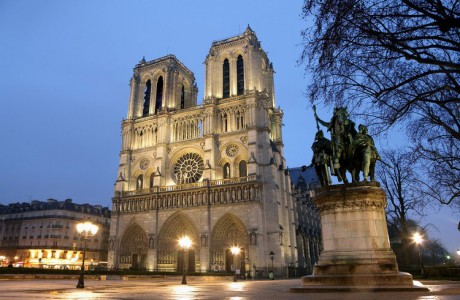
ft) high and 70 meters (225 ft) wide (The whole of Notre-Dame
cathedral would fit in its frame), was entitled "La Grande
Arche". This monument, dedicated to Fraternity, is built
of concrete with a facing of Carrara marble and grey granite.
On the esplanade are works by Takis, fountains, luminous
signals and statues by Mirò. Various ministries have
their offices in the massive supporting pillars, the human
rights commission (Fondation des Droits de l'Homme) and
major corporations have their office there. The Arche also
includes a large exhibition hall.
Seated up above on the terrace one can admire the impeccable
success of its perspective, whose lines can be followed
to the Arc de Triomphe, along the Champs-Elysées
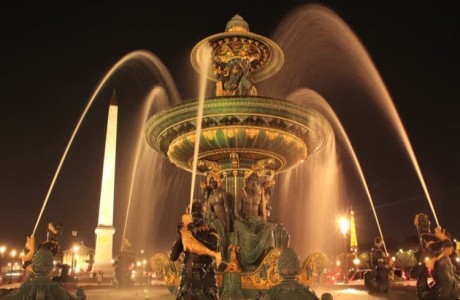
to the obelisk on Place de la Concorde, over the Tuileries
gardens to the Louvre's Cour Carrée.